
Is AMSOIL API-certified and dexos-approved? Here’s why that’s not a concern
Quick answer
Some AMSOIL oils are API-licensed and some aren’t, and that isn’t a concern for how the oil protects your engine. AMSOIL says its OE line is licensed by the American Petroleum Institute. Signature Series is listed on AMSOIL’s November 2026 data sheet for applications requiring API SQ and GM dexos1 Gen 3, which is AMSOIL saying it meets those specs, not that it holds a license, and I didn’t find an AMSOIL listing on GM’s public dexos lists on November 17, 2026. AMSOIL’s documented position is that a license is a minimum standard, that full licensing would lock its formulas to specific synthetic base stocks and slow improvements, and that its published Sequence IIIH, Sequence IX, Sequence IVA, NOACK and GM turbo-coking results show Signature Series beating the same kinds of tests those specs use. The Magnuson-Moss Warranty Act also says a manufacturer can’t void a warranty just because you used a different brand; it has to show the oil caused the damage.
Yes: AMSOIL’s OE line is API-licensed, Signature Series is not, and when I checked GM’s public dexos lists on November 17, 2026, I didn’t find an AMSOIL-branded product on them. That’s the honest part, and it isn’t hidden. The more useful question is whether a missing license mark means weaker protection or a voided warranty. On AMSOIL’s own published record, the answer is no.
Why that’s not a concern
This is the part most pages skip, and it’s the part that actually answers the worry.
A license is a minimum, not a quality ranking
AMSOIL’s FAQ is direct about what an API license is: it means a specific formula “has passed the minimum performance standards” in a set of laboratory and engine tests. Those minimums are set by the API Lubricants Committee (representatives from automobile, oil and additive companies), and they cover areas such as wear, deposits, fuel economy and emissions. Passing them, and paying to display the API “donut” and “starburst,” is not the same thing as being the best oil in those tests.
The same FAQ explains how a lot of licensed oil gets made. Additive companies develop licensed formulas and offer them to oil companies to re-license. AMSOIL says “it is inexpensive to re-license one of these formulas,” that “the majority of oil companies choose to do this to avoid the costs associated with testing their own formulas,” and that “the same chemistry is being sold under many brand names.” AMSOIL says its own lubricant formulas are unique and proprietary.
Why AMSOIL doesn’t license every oil, including Signature Series
AMSOIL’s FAQ does not say Signature Series failed a licensing test. It says full API licensing would box the company in.
API licensing, AMSOIL notes, was originally developed for mineral-based oils and gives those oils more manufacturing flexibility than synthetics. Conventional petroleum base stocks can use a “base stock interchange” program: with paperwork and a few minor tests, a company can buy the same chemistry from more than one supplier. Synthetic base stocks are supplier-specific. If a formula was tested with an ester from one supplier, only that supplier’s ester can be used in a licensed formula. Using the same ester from a second supplier would require complete engine testing, which, AMSOIL says, usually isn’t done because of the cost. The result is supply-disruption risk and less room to negotiate.
That’s why AMSOIL’s FAQ says that if all of its motor oils were API licensed, “the company could not source new raw materials from multiple suppliers, which would greatly increase the threat of supply disruption and the likelihood of extraordinarily high prices.” The second reason is speed: “licensing formulas limits the ability to quickly adopt new technologies as they are discovered; each variation from the originally licensed formula requires re-submission for complete engine testing.”
AMSOIL also explains how it still aims to meet or exceed the tests behind those licenses. It says it works with major additive companies to select top-performing passenger-car and heavy-duty diesel additives that have already passed API licensing requirements, then maximizes the amount of additive used and boosts selected performance areas, unlike companies that, “because additives are expensive, use the minimum amount of the least expensive additives required to meet the minimum API requirements.” It then uses synthetic base stocks and a high-quality viscosity-index improver, and it verifies the finished oil with laboratory, field and used-oil analysis. AMSOIL says it has been collecting used synthetic oil samples from passenger cars since 1982 and reviews tens of thousands of oil-analysis tests a year.
AMSOIL’s published results in the same kinds of tests
This is the evidence that matters more than a mark on the label. AMSOIL publishes Signature Series results in the industry engine and bench tests that sit behind API and dexos specifications. These are AMSOIL’s claims, with the test and the grade named. I’m not inventing numbers, and I’m not treating them as a head-to-head against a store brand AMSOIL didn’t name in the test.
| Test | AMSOIL’s published result | What it was measured against |
|---|---|---|
| Sequence IIIH (piston deposits), Signature Series 5W-30 | 72% more protection against piston-deposit formation than required. In a double-length Sequence IIIH test, 31% better protection than required. | The industry Sequence IIIH deposit requirement used for API / ILSAC licensing |
| Sequence IX aged-oil LSPI (modified), Signature Series 5W-30 | 4X more piston protection against low-speed pre-ignition, even after a 25,000-mile service interval. AMSOIL aged the oil for 25,000 miles in a Ford Raptor 3.5L high-output EcoBoost instead of the standard laboratory aging that simulates about 4,000 miles. | The Sequence IX LSPI protection requirement; AMSOIL discloses that this was a modified, more severe aging protocol |
| ASTM D5800 NOACK volatility, Signature Series 0W-20 | 2X better protection against volatility. AMSOIL reports 7.2% volatility versus a 15% maximum. | The API SQ / ILSAC GF-7 maximum allowable volatility |
| Sequence IVA wear (ASTM D6891), Signature Series 0W-20 | 75% more engine protection against horsepower loss and wear than required. AMSOIL reports average cam wear of 20.28 versus an industry-standard value of 90 (lower is less wear). | The Sequence IVA limit as required by the API SN specification |
| GM turbo-coking test, Signature Series 5W-30 | Protects turbochargers 72% better than required. | The requirement in the GM dexos1 Gen 2 turbo-coking test |
AMSOIL also ran a 125,000-mile accumulation study with Signature Series 5W-30 in a 2025 Ford F-150 Raptor 3.5L high-output engine, changing the oil at 25,000-mile intervals. AMSOIL reports that horsepower and torque were maintained from the start of the test to the end, and that the oil screen had 0% plugging. That’s a field demonstration, not an API license test, but it’s the kind of real-world check AMSOIL points to when it talks about protection over a long drain.
Your factory warranty is not hanging on a donut
Using an oil that isn’t API- or dexos-licensed is not, by itself, a reason a manufacturer can throw out your warranty.
The federal Magnuson-Moss Warranty Act (15 U.S.C. § 2302(c)) says a manufacturer can’t condition a written or implied warranty on your using a product identified by brand, trade or corporate name unless it provides that product free. AMSOIL’s guarantee page puts the practical rule in plain language: it is illegal to tie warranty coverage to the brand of lubricant you use unless the manufacturer provides that lubricant free of charge, and “manufacturers can’t deny warranty coverage without showing the aftermarket part or lubricant caused a failure.” AMSOIL’s FAQ says the same thing in shorter form: “Using AMSOIL synthetic motor oil has no affect on vehicle warranties.”
AMSOIL also backs the oil with its own Limited Warranty. Its guarantee page says it does not place restrictions on that coverage based on total vehicle miles, and that “we stand behind our products for as long as you use them.” If a dealer ever claimed that using AMSOIL violated the factory warranty, AMSOIL tells customers to contact AMSOIL Technical Services. The legal background, the receipts you should keep, and what to do if a claim is denied are on Does AMSOIL void your warranty?.
A long, documented track record
This only counts where AMSOIL has actually published it, so I’ll stay with that.
AMSOIL’s About page and FAQ both state that in 1972, AMSOIL 10W-40 Synthetic Motor Oil became the first synthetic motor oil to meet American Petroleum Institute service requirements. The same About page says AMSOIL validates its lubricants in long-range studies with taxicabs, delivery fleets, police and emergency vehicles, and over-the-road trucks, and that further testing happens in racing (off-road trucks, stock cars, high-powered boats, dirt bikes and snowmobiles) under AMSOIL’s “Racing is Research” banner. Combined with the used-oil analysis database AMSOIL says it has been building since 1982, that’s a much longer public record than a missing logo on a label.
Meets vs. licensed: what’s the difference?
These two words get mixed up constantly, which is why the license question sounds scarier than it is.
- Meets (or “recommended for”) a spec: the oil maker says the formula performs to the specification. AMSOIL’s data sheets phrase it as “use in applications that require any of the following specifications.”
- Licensed: the formula went through the spec owner’s program and the marketer can print the mark. For API that’s the “donut” on the back label and the “starburst” on the front. For GM it’s the dexos mark with a license number printed on the bottle, and the product shows up on GM’s list.
A licensed oil isn’t automatically better. It means the formula passed the program’s minimums and the license is current.
Which AMSOIL oils are API-licensed?
| Line | What AMSOIL says | Typical use |
|---|---|---|
| OE Synthetic Motor Oil | “Licensed by the American Petroleum Institute (API),” with the Resource Conserving designation (OE product page) | Owners who want the API license mark and plan to follow the OEM drain interval |
| Signature Series | Data sheet G2880 (11/26) lists 0W-20, 5W-20, 0W-30, 5W-30 for applications requiring API SQ (Resource Conserving), ILSAC GF-7A and GM dexos1 Gen 3; 0W-40 and 5W-50 list GM dexos R. No license claim on the product page. | Maximum protection; up to 25,000 mi / 1 yr normal service. This is the line behind the test results above. |
| High-Mileage | Data sheet G3831 lists API SQ and GM dexos1 Gen 3 (0W-20, 5W-20, 5W-30) | Engines over 75,000 miles; up to 12,000 mi / 1 yr |
Is AMSOIL dexos approved?
AMSOIL’s data sheets list several grades for GM dexos1 Gen 3 (Signature Series, OE and High-Mileage in 0W-20, 5W-20 and 5W-30) and its 0W-20 Synthetic Diesel Oil for GM dexosD. That’s AMSOIL saying the oils meet those specs. AMSOIL’s specifications blog uses the same “recommended for applications that require” language for API SQ, ILSAC GF-7 and GM dexos1 Gen 3.
GM publishes its licensed brands at gmdexos.com. On November 17, 2026 I checked the dexos1 Gen 3, dexosD and dexos R lists and did not find an AMSOIL-branded listing. (For comparison, the dexos R list included Pennzoil Ultra Platinum, with license numbers printed on its data sheet.) GM’s lists change, so check them yourself if you want the current snapshot. The missing listing is the fact I started this page with. It is not, on AMSOIL’s published testing and warranty record, evidence that the oil falls short of the tests behind the spec.
If your warranty paperwork asks for a licensed oil
This is the one case I’ll put plainly, and I’ll keep it short.
Some GM owner’s manuals ask for dexos-approved oil “or equivalent” of the right viscosity, and they warn that damage from the wrong oil isn’t covered. If you want the dexos mark and license number on the bottle while the factory warranty is running, so a service writer never has to look past the label, you can use a currently listed dexos-licensed oil of the right viscosity until the warranty ends, then switch. That’s a reasonable paperwork preference. It is not a finding that Signature Series, or AMSOIL 0W-20 Synthetic Diesel Oil, failed the underlying tests.
If you’re comfortable with AMSOIL’s spec statement, the published test results on this page, Magnuson-Moss, and AMSOIL’s own Limited Warranty, use the AMSOIL grade your lookup shows, match the viscosity in your manual, keep every receipt, and change oil on the manual’s schedule (or the oil-life monitor) while the factory warranty is in force. Either path still requires the right viscosity.
What about Ford, Ram and diesel trucks?
Ford and Chrysler/Stellantis specs (Ford WSS-M2C…, Chrysler MS-…) are listed on AMSOIL’s data sheets the same way. Ford doesn’t run a public license list like GM’s dexos program, so “meets the WSS spec” is the normal way oils are described. For diesels, AMSOIL lists API CK-4 and engine-maker specs on its Max-Duty data sheet. My diesel oil guide and truck pages cover each engine. The 3.0L Duramax is the one GM diesel that points at dexosD; I cover that licensing question, and why it isn’t a concern, on the 3.0 Duramax page.
Most protection AMSOIL publishes
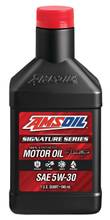
AMSOIL Signature Series 5W-30 100% Synthetic Motor Oil (ASL)
Best for: Gasoline engines that call for 5W-30; also offered in 0W-16, 0W-20, 5W-20, 0W-30, 10W-30, 0W-40 and 5W-50. This is the line behind the Sequence IIIH, Sequence IX, Sequence IVA and turbo-coking results above.
- 72% more piston-deposit protection than required (Sequence IIIH, 5W-30)
- 4X more LSPI protection than required after a 25,000-mile interval (modified Sequence IX, 5W-30)
- 75% more wear protection than required (Sequence IVA, 0W-20)
- Guaranteed protection up to 25,000 miles or 1 year in normal service
Tip: Preferred Customers get member pricing. Join at AMSOIL.com
Want the API license mark on the bottle instead? AMSOIL’s OE line is the licensed option, and it’s built for the factory drain interval. Compare the three gasoline lines in Signature Series vs Extended-Life vs OE.
API, the API donut and starburst marks are trademarks of the American Petroleum Institute. GM and dexos are trademarks of General Motors. Ford, EcoBoost, F-150 and Raptor are trademarks of Ford Motor Company. Pennzoil and Ultra Platinum are trademarks of their owners. Used for identification only. Test percentages and multiples on this page are AMSOIL’s published claims for the named grades and tests, not savings claims.
Frequently asked questions
Is AMSOIL API certified?
Why isn’t AMSOIL Signature Series API licensed?
Is AMSOIL dexos approved?
Can I use AMSOIL in my GM car under warranty?
Does a missing API or dexos license mean the oil is weaker?
Is AMSOIL OE better than Signature Series?
Sources
Product facts on this page come from AMSOIL’s official product pages and literature. Always follow your owner’s manual.
- AMSOIL FAQ: API Licensing (what a license is, why AMSOIL doesn’t license all oils, and how it says it meets or exceeds the tests)
- AMSOIL Signature Series data sheet (G2880, 11/26): applications
- AMSOIL OE 5W-30 product page: ‘Licensed by the American Petroleum Institute (API)’
- AMSOIL Performance Tests (Sequence IIIH, Sequence IX LSPI, NOACK volatility, 125,000-mile Raptor study)
- AMSOIL Blog: Clean Pistons, Signature Series and the Sequence IIIH Test
- AMSOIL Blog: Protecting Against LSPI, Even During Extended Drain Intervals
- AMSOIL Signature Series 5W-30 product page (Sequence IVA wear test; GM dexos1 Gen 2 turbo-coking test)
- AMSOIL Guarantee (Magnuson-Moss Warranty Act; AMSOIL Limited Warranty; Warranty Secure)
- AMSOIL Blog: Your Manufacturer’s Warranty is Secure
- AMSOIL FAQ: Vehicle Warranty and AMSOIL (Magnuson-Moss; extended drains; Limited Warranty)
- The AMSOIL Story (1972 first API-meeting synthetic; fleet and racing validation)
- AMSOIL Blog: Motor Oil Specifications Explained: API SQ, ILSAC GF-7 and dexos
- GM dexos licensed brands (dexos1 Gen 3, dexosD, dexos R), checked Nov 17, 2026
- AMSOIL Synthetic Diesel Oil data sheet (G3713): 0W-20 dexosD
- 15 U.S. Code § 2302(c): Magnuson-Moss Warranty Act, Cornell LII
- Chevrolet owner’s manual (2020 Equinox): Selecting the Right Engine Oil, dexos caution