
Diesel winter prep: gelling and cold starts
Quick answer
Treat diesel fuel with an anti-gel additive before it reaches its cloud point, then use the lowest winter viscosity your owner’s manual allows. AMSOIL notes most diesel fuels have a cloud point near 32°F (0°C). AMSOIL Diesel Cold Flow and Diesel 4-IN-1 both lower the cold filter-plugging point by up to 40°F (22°C). Anti-gel does not reverse fuel that has already gelled; for that, use Diesel Recovery. On the Front Range, that often means treating tanks in the fall, not after the first subzero morning.
I live on the south side of Denver. Front Range winters can go from a mild afternoon to a hard cold start in the mountains the next morning, and that’s when diesel pickups get left on the shoulder. Two separate problems get blamed on “winter”: fuel that gels, and oil that’s too thick to crank. They need two different fixes.
1. Keep the fuel from gelling
Diesel contains natural wax. As it cools, the wax crystallizes (the cloud point), then crystals collect on the fuel filter until it plugs (the cold filter-plugging point, CFPP). AMSOIL notes most fuels have a cloud point near 32°F (0°C). Anti-gel additives have to be mixed in before that happens.
In Colorado, don’t wait for a forecast of zero. Overnight lows in Denver and along I-70 can drop through the cloud point in fall, and mountain trailheads or a hunting camp are colder than the city. Treat the tank, then keep treating as you refill. Timing and treat rates are also covered on when to add diesel anti-gel.
The full bottle-by-bottle comparison is in the diesel fuel additives guide. The short winter version:
| Diesel Cold Flow (ADD) | Diesel 4-IN-1 (ADB) | |
|---|---|---|
| Anti-gel (lowers CFPP) | Up to 40°F (22°C) | Up to 40°F (22°C) |
| Also does | Dedicated anti-gel; inhibits filter icing; helps in storage | Injector cleaning, lubricity, up to 4 points of cetane |
| Use it when | You want a dedicated winter anti-gel | You want one bottle for winter and year-round cleaning |
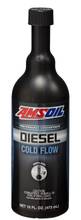
Dedicated anti-gel
AMSOIL Diesel Cold Flow Fuel Additive (ADD)
Best for: Treating every winter tank and stored fuel in a diesel pickup, before the cold arrives.
- Lowers cold filter-plugging point (CFPP) by up to 40°F (22°C)
- Prevents wax settling during storage; inhibits fuel-filter icing
- Safe in all diesel fuels, including biodiesel, per AMSOIL
Tip: Preferred Customers get member pricing. Join at AMSOIL.com
One-bottle winter choice
AMSOIL Diesel 4-IN-1 Fuel Additive (ADB)
Best for: Diesel owners who want anti-gel, injector cleaning and cetane in one dose.
- Combines the benefits of Diesel Injector Clean, Diesel Cold Flow and Diesel Cetane Boost
- Lowers CFPP by up to 40°F (22°C)
- Increases cetane up to 4 points
Tip: Preferred Customers get member pricing. Join at AMSOIL.com
If the tank has already gelled, anti-gel won’t undo it. Use AMSOIL Diesel Recovery.
2. Pick an oil that will crank
Thick oil makes a cold diesel hard to start and slow to lubricate bearings and the turbo. Use the lowest “W” viscosity your owner’s manual allows. AMSOIL Max-Duty grades that meet Ford WSS-M2C171-F1 include 10W-30, 5W-40, 0W-40 and 15W-40 (G3467). On many Duramax lookups, AMSOIL specifically calls for 5W-40 below 0°F to improve cold starting.
I run Max-Duty 10W-30 in my 2019 F-350 6.7 Power Stroke and change it when the Ford oil-life light comes on. If you park outside through regular subzero mornings, look at 5W-40 or 0W-40 if your manual allows it. More in the cold-weather oil guide and the 6.7 Power Stroke guide.
A simple Front Range checklist
- Treat the tank in the fall, then treat every fill through winter.
- Confirm the viscosity on AMSOIL’s lookup and in your manual; don’t stay on 15W-40 just because that’s what the last shop poured.
- Keep the fuel filter in good shape. A loaded filter plugs sooner when wax starts to form.
- Use the block heater when the truck sits in real cold. It helps the engine and the oil, not just the coolant.
- Carry a plan if it gels anyway: Diesel Recovery, and don’t keep cranking a truck that won’t fire.
Related guides
- Diesel fuel additives: Cold Flow vs 4-IN-1 vs Cetane Boost
- AMSOIL heavy-duty diesel coolant (ANTHD)
- AMSOIL coolant and Coolant Boost
- Cold-weather synthetic oil
- Diesel oil: which AMSOIL for your truck
- 6.7L Power Stroke oil guide
- 7.3L Power Stroke diesel kit
- LBZ and LMM Duramax kits
- AMSOIL vs Shell Rotella
Ford, Super Duty and Power Stroke are trademarks of Ford Motor Company. AMSOIL is a registered trademark of AMSOIL INC.; I’m an Independent AMSOIL Dealer, not AMSOIL INC.
Frequently asked questions
When should I add anti-gel to diesel in Colorado?
What’s the difference between Diesel Cold Flow and Diesel 4-IN-1?
Can a fuel additive fix gelled diesel?
What oil viscosity should I run in a Colorado winter?
Does blending #1 diesel prevent gelling?
Sources
Product facts on this page come from AMSOIL’s official product pages and literature. Always follow your owner’s manual.